

Table of contents
I noticed this discussion in an online space recently, and I think that many educators feel a similar way:
Reviewing and giving thoughtful feedback on clinical paperwork is time-consuming!
When I was a new instructor, I experimented with a 'just-in-time' review approach for students. This method involves providing feedback and making suggestions at the most opportune moment, such as during the clinical shift, rather than after the fact. It allows students to apply feedback immediately and maximizes clinical time to work on not just paperwork, but also their thought processes.
Nothing is more frustrating for a clinical nurse educator than spending hours reviewing paperwork, only to have students never really read the feedback or have no chance to apply it to patient care.
Plenty of ideas exist for alternative clinical assignments, or even eliminating clinical paperwork altogether, but those changes can take years to get faculty buy-in. Even if you have no say over the type of paperwork your students submit, the ten ideas below are small changes you can make on your own, starting with your very next clinical day.
Below are ideas to help educators shorten review time, provide timely feedback, and suggest changes that can meaningfully impact patient care.
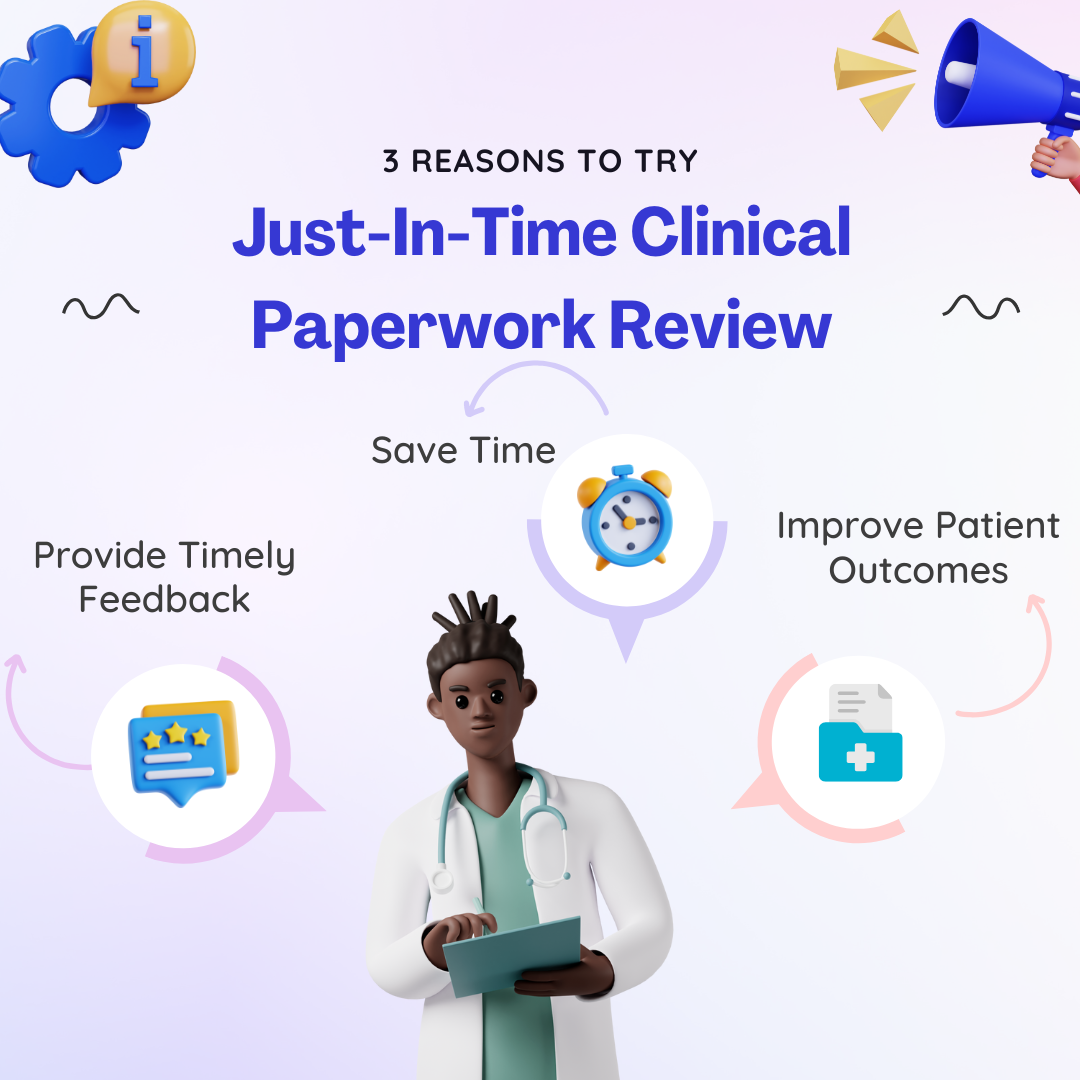
⏱️ Benefits of Just-In-Time Nursing Clinical Paperwork
There are three main benefits to using Just-In-Time Clinical Teaching Techniques:
- Saving Time - reviewing paperwork at the clinical site without taking it all home
- Providing Useful Feedback - getting comments to students while the experience is still fresh
- Improving Patient Care - helping students see their own impact in real time
Here is what each one looks like in practice:
⏰ Benefit 1: Saving Time
By intentionally using pre- and post-conference periods, you can significantly reduce the time you spend reviewing nursing clinical paperwork outside of working hours.
Idea #1 - Move Prep to the Morning of Clinical
Move clinical prep time to the morning of the clinical day itself, rather than the night before.
In my clinical groups, students arrive 90 minutes before their shift starts, and I gradually shorten that prep window as they gain confidence and skill navigating the medical record. Students should do a focused EMR review, but, just like a working nurse, most of their real insight comes from report and their own assessment, not the chart.

Idea #2 - Run a Short 1:1 Readiness Check-In
Before clinical begins, meet briefly with each student to check their clinical readiness: their understanding of key concepts, planned interventions, and anticipated complications. This lets you catch knowledge gaps immediately and tailor your teaching in real time.
It also helps students synthesize their patient information, ask clarifying questions, and identify their own learning priorities for the day, which sets both of you up to use your time well once clinical starts.

Idea #3 - Build Structured Paperwork Time Into Post-Conference
Set aside dedicated time in post-conference for finishing paperwork rather than sending it all home.
Try peer or group review, and set a timer (15 minutes works well) and I've found a timer alone noticeably improves focus.
On a two-day rotation, the second day tends to go more smoothly: students already know their patients, have prepped their medications, and understand the plan of care, so it's the better day to prioritize paperwork review.
If you have an hour of post-conference scheduled, give students an independent worksheet or activity to do while you review paperwork 1:1 for 10 minutes with each student. This talking through the patient in real-time is so valuable as a learner and keeps you from bringing home everything to review.

Idea #4 - Use Small Incentives for Day 1 Completion
Consider a small reward or points system for completing paperwork on the first clinical day. Students tend to use their "downtime" much better when something motivates them to do it.

Idea #5 - Claim Small Pockets of 1:1 Review Time
On that smoother second day, look for small windows, even just 10 to 15 minutes, to sit with an individual student and review their paperwork together.
You won't always get to everyone, but even two or three reviews by the end of the day can considerably cut down the grading you'd otherwise take home.

📝 Benefit 2: Providing Useful Feedback
Feedback is most effective when it's delivered promptly and constructively. A just-in-time system lets you give feedback while the clinical experience is still fresh. Because by the time students get your (excellent) feedback the following week, they've often lost the thread of their patient or the situation entirely.
The research supports this: students who receive feedback shortly after an experience are better able to carry that learning into future clinical practice (Rowbotham & Owen, 2015). Burgess et al. (2020) similarly found that immediate, effective feedback is essential for promoting self-reflection, motivating learners, and improving clinical performance.
Timing isn't a small detail. It meaningfully shapes the learner experience.
Idea #6 - Set a Structured Feedback Schedule
Build a predictable rhythm: review parts of their paperwork on a set day, like Tuesday. Maybe it is lab values and diagnostics. Then, on Wednesday, review the full care plan.
Students get time to reflect and apply changes while their experience is still vivid, and the consistency builds accountability and expectation that these things are completed on certain days.

Idea #7 - Take Notes Tied Directly to Learning Outcomes
Structure your own notes around your school's learning outcomes as you observe students during the day.
Notes like "understood how to draw up medication from a vial" or "connected blood pressure to fluid volume status" are really valuable when you are writing your student evaluations.
For example, learning outcome #3 in our curriculum was around pharmacology knowledge. And throughout the day, when I would pass a medication with a student, or they explained to me how an ACE inhibitor worked, I would take a note and connect it directly to the learning outcome. It made writing weekly evaluations a breeze.
When a student isn't meeting an outcome, this gives you specific, concrete examples to point to instead of a vague impression.

Idea #8 - Set Up a Dedicated Review Space
Find a somewhat private spot on the unit where you can work with students one-on-one during the day. This could be a back nurse's station, an empty patient room, whatever's available.
Having a small, consistent workspace makes it much easier to review documentation and give feedback in the moment.
I would call this space my "office" and students would know that between 12:30-1:30 I would be there reviewing charting and having 1:1 meetings with students.

Idea #9 - Build a Feedback Bank
A feedback bank is a collection of pre-written comments you can pull from as a starting point, rather than composing every comment from scratch. My friend and fellow educator Natasha Nurse-Clarke has a full masterclass on building one if you're taking paperwork home to grade.
If your school uses a platform like Canvas, this function often already lives in the gradebook, which makes it even easier to give timely, constructive feedback.
Take the time to set this up and it will save you time in the future.

🛏️ Benefit 3: Benefit 3: Improving Patient Care
The third benefit is that students can actually see their work play out in a clinical setting. When paperwork review happens in the moment instead of a week later, students can watch their own clinical reasoning play out on a real patient, in real time. That immediacy is where the deepest learning happens, and helps students connect the thinking they are demonstrating with the paperwork to actual patient care.
Idea #10 - Set a Patient-Centered Goal on Day 1
During pre-conference, ask students to set a clear, patient-centered focus for the week. This should help them prioritize care and interventions from day one.
Seeing their own plan play out is a real source of pride for students: noticing that ambulating their patient improved a respiratory assessment, or catching a complication they'd prepared for. That connection between their plan and a real outcome is what clinical education is all about, and it's also where just-in-time feedback pays off the most.
Students get to see the impact of their care while it's still happening.

Conclusion
If you're feeling overwhelmed by grading or squeezed by a time crunch around clinical paperwork, these ten ideas are a place to start.
Pick one or two rather than trying all of them at once. Saving time, giving timely feedback, and helping students see their impact on patient care are connected, and small changes to your pre- and post-conference routine can save you time and energy while still providing meaningful learner experiences for your students.
You don't need to overhaul your paperwork to fix the time crunch. Even without control over the assignment itself, restructuring when and how you review it (morning prep, structured post-conference time, small pockets of 1:1 review) can meaningfully cut down what you take home.
Timing is as important as the feedback itself. Research backs up what most educators already sense: that feedback given while the clinical experience is still fresh gets absorbed and applied, while feedback delivered a week later arrives after the details have faded.
The real win is improving patient care. When students get feedback in the moment, they get to see their own clinical reasoning play out in real time.

Martha Johnson
Martha Johnson, MSN, RN is a nurse educator and the creator of BreakoutRN. She helps nursing faculty build active learning into the classroom and clinical setting, one practical idea at a time, using tools that support clinical judgment, engagement, and real-world nursing practice.
Frequently Asked Questions
My clinical group has 8–10 students. Is a 1:1 readiness check-in realistic?
Yes, especially if you keep each one short. Even 2-3 minutes per student adds up to real insight without eating up your whole clinical day. Also, rotating who gets a slightly longer check-in can work as well.
What if my school's clinical paperwork format is fixed and I have no say over it?
That's exactly the situation this approach is built for. None of these ideas require changing the assignment itself. Instead, they change when and how you review it, which is entirely within your control even if the paperwork format isn't.
I don't have a private space on my unit. What else can work?
A dedicated space helps, but it's not required. A quiet corner of the break room or five minutes in the hallway between patients can work for a quick review. Consistency and structure matter more than the specific location.
How do I start a feedback bank without a huge time investment upfront?
Start small and save your comments as you write them during a normal grading week, instead of trying to build the whole bank in one sitting. Within a semester or two, you'll have a working set of go-to phrases for common strengths and common gaps.

