

Table of contents
✏️ The Carpool Retrieval
After I pick my kids up from school, I get a full rundown of the day and the roller coaster of events that is elementary school. These types of discussions, with a friend or your partner, that re-hash the events of the day are actually an excellent way to practice retrieval.

🦴What is Retrieval Practice?
Retrieval practice is an essential skill for a learner to master. It involves reconstructing information you learned in the past and bringing it in a new form to the present moment.
For nursing students, this is a vital skill to bridge the academic-practice gap and allow students to bring what they learn in theory to clinical.
Research suggests that when a memory is retrieved, our minds alter it. Every time it is retrieved, it becomes more flexible and durable, allowing it to be used as a reference for future situations. In addition, if a memory or retrieved information is tied to an emotion, it becomes even more lasting.
In one study, researchers put students into two groups. One group read and re-read text about the pathophysiology of the respiratory system. The other group read the identical text but then typed what they could remember into a virtual notebook (a type of retrieval practice). One week later, students who practiced retrieval (reading and then writing) performed better on the short exam.
In addition, they could also answer questions about respiratory diseases, such as polio, even though it was not covered in the text. Retrieval practice allowed them to apply the information they had learned about the respiratory system muscles to a new situation.
💡 Ideas for Retrieval Practice in Nursing Education
Here are three ideas that you can use in your classroom where students practice retrieval:
📉 Low Stakes/No Stakes Quizzes
While we can offer a variety of assessment types in our courses, there is simply no way around the fact that to be a nurse, you will need to take a high-stakes exam.
But just like you would not register for a marathon and only train on a bike, we cannot expect students to perform on an exam and never “train” for the event. Research suggests that when the pressure to perform well on a test increases, the learning benefits from retrieval can decrease.
Instead, consider offering frequent low-stakes or no-stakes quizzes. Just as runners cross-train, exposing students to various forms of test-taking can increase their ability to perform. And research has shown that frequent quizzing in the classroom can reduce test anxiety. A win all around!
⚡Put it into action: Add a few low-stakes questions to the end of theory or clinical sessions. Bonus points if you can offer alternative format questions.
🏗️ Scaffolding with Concept Maps
Have you ever struggled to start a task from a blank page? It seems that even the most basic outline can help the brain categorize and organize information. Using a concept map outline and providing a framework for note-taking can also help students practice retrieval.
When assigning a short lecture section or asking students to read a textbook section before class, offer a partially completed concept map or a diagram to connect and scaffold the information. It can look something like this:
📥 Download this Template
You can create a free Canva account and modify it to fit your needs.
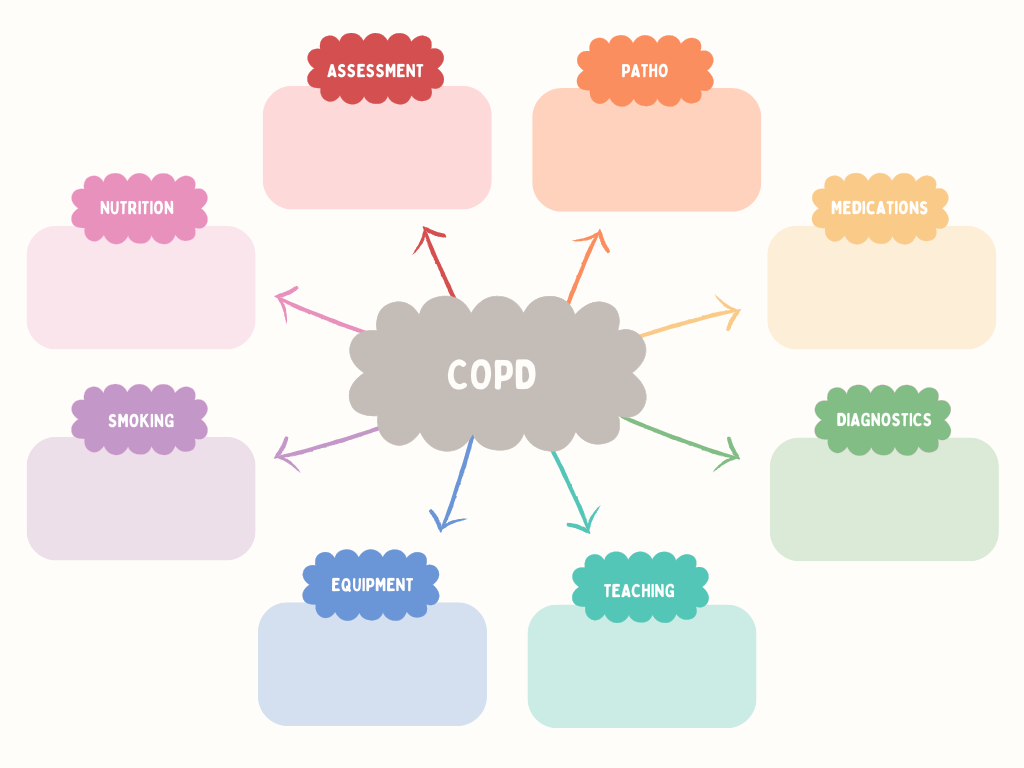
📝 Using a Concept Map Template
You can use this concept map note-taking exercise with any content you teach.
- First, ask students to retrieve information from memory and fill out as much of the map as possible independently.
- Then, they can work with a partner or reference the text to fill in the gaps.
Providing the outline or scaffold is an effective technique to practice retrieval in nursing education.
For more information about using this technique in note-taking, here is an article on active note-taking that gives examples of creating fill-in-the-blank-style slides to improve student note-taking.
⚡Put it into action: Add a quick concept map worksheet after you cover a disease process. Be sure to allow some time between the learning and retrieval.
🎴 Modified Flashcards
Flashcards can be a great way to learn and recall basic definitions. And repetition is a great way to practice the foundational topics of Bloom’s taxonomy - remembering and understanding. With a simple modification to flashcards, you can help students use this tool to access higher application and analysis levels.
Create two stacks of flashcards.
- The first stack is TRADITIONAL of cards used for remembering and understanding. For example, using the COPD example lesson, you would include COPD interventions or beta-agonists for the pharmacology section.
- Then, the second stack is the CONCEPT SET and includes instructions for application exercises. These could include:
Compare/Contrast
Pick two traditional cards and describe how they are related or different.Real-Life
Choose one traditional card and think of a real-life example- Teach It Out Loud
Choose one traditional card and explain it as if you’re teaching a first-semester nursing student. - Clinical Prioritization
Choose two traditional cards and decide which one would be the priority in a patient scenario — explain why. - Patient Education Translation
Choose one traditional card and explain it in plain language to a patient with a 6th-grade reading level. - Complication Connection
Choose one traditional card and describe a potential complication related to it. - Medication-to-Condition Link
Pick one pharmacology traditional card and connect it to the pathophysiology it treats. Explain the mechanism of action. - What If Scenario
Choose one traditional card and create a “what if” variation (e.g., What if the patient also has heart failure? What if they are elderly?). - Assessment Tie-In
Choose one intervention traditional card and identify what assessment findings would indicate it is effective. - NCLEX-Style Question Creation
Pick one traditional card and write a one-sentence NCLEX-style question stem related to it. - Error Spotting
Choose one traditional card and describe a common mistake students or new nurses might make related to this concept. - Sequence It
Choose three traditional cards and arrange them in the correct clinical order or priority sequence. - Red Flag Identification
Pick one traditional card and describe a finding that would require immediate intervention. - Documentation Practice
Choose one traditional card and write a brief nursing documentation note that reflects its application in practice. - Interdisciplinary Lens
Pick one traditional card and explain how another member of the healthcare team (respiratory therapist, pharmacist, physical therapist, etc.) would be involved. - Opposite Scenario
Choose one traditional card and describe what could happen if this intervention is delayed or performed incorrectly. - Patient Story Builder
Draw three random traditional cards and create a short patient scenario that incorporates all three.
This simple modification can help students access higher levels of thinking and get extra retrieval practice from a set of flashcards.
⚡Put it into action: Teach students how to create a set of basic flashcards as well as modified flashcards.
🏅 Importance of Retrieval Practice
Retrieval practice can feel difficult or repetitive, and students may feel that these activities are not productive because they do not see immediate results. However, just like exercise, the results are expected over the long run rather than immediately.
Nurse educators can use low stakes/no-stakes quizzing, scaffolding with concept maps and modified flashcards as active learning tools to practice retrieval. These types of activities ensure that our students are ready for the NCLEX exam and more importantly, clinical practice.
Conclusion
Retrieval strengthens learning. Bringing information back to mind makes it more durable, flexible, and easier to apply in new clinical situations.
Low-stakes practice reduces anxiety and improves performance. Frequent quizzing, concept maps, and modified flashcards build confidence without increasing stress.
Application + repetition = ability to act at the bedside. When students retrieve and then apply information, they bridge the gap between classroom knowledge and clinical reasoning.

Martha Johnson
Martha Johnson, MSN, RN is a nurse educator and the creator of BreakoutRN. She helps nursing faculty build active learning into the classroom and clinical setting, one practical idea at a time, using tools that support clinical judgment, engagement, and real-world nursing practice.
Frequently Asked Questions
Is retrieval practice just like “more testing”?
If it’s only used as graded assessment, it can. But retrieval practice works best when it is low-stakes or no-stakes. The goal is not evaluation. The goal is strengthening memory and building application skills. Short quizzes, exit tickets, concept maps, and modified flashcards all allow students to practice retrieval without the pressure of a high-stakes exam.
What if students resist retrieval practice because it feels hard? Or worse, boring?
Retrieval is more effortful than re-reading notes, but that effort is what strengthens memory. You can help students understand that the discomfort is productive, similar to muscle soreness after a workout. The results are long-term, even if they are not immediately visible.
How often should I use retrieval practice in my course?
Retrieval practice works best when it is spaced and repeated over time. Even 3–5 minutes at the end of a class session, a quick low-stakes quiz, or a short concept map exercise can make a meaningful difference. The key is consistency, not complexity.
Additional Active Learning Ideas & Inspiration


Looking for additional active learning tools?
Clinical Decision Cards are a great way to bring variety to your teaching toolbox. Available in:
- Medical/surgical
- OB
- Mental Health
- Peds