

Table of contents
The first day of clinical orientation is pivotal for students and faculty.
Students may feel anxious, uncertain, and intimidated by the new environment. At the same time, instructors struggle to deliver essential clinical information (where are the clean sheets again?), establish a supportive learning environment, and build meaningful connections with the students.
While learning the clinical paperwork and walking through the unit are both important, maybe you are looking for fresh ideas to invigorate orientation day and pave the way for a successful clinical experience.
This article explores two innovative ideas to help nursing instructors run a stellar orientation day.
They also serve as an active-learning "warm-up," setting the tone for continued success with active-learning techniques. Using one or both of these activities, you will see increased engagement and build a sense of community from the start.

💡 Idea #1 - Orientation Day Chart Review
Best for: Helping students navigate the documentation system.
Beginner Students
This idea works best for students who are new to a charting system.
- Choose one patient from the unit. All student groups will work with the same patient.
- Pair students together and give them access to the EMR.
- Sssign each group to research one section of the EMR. These sections may include:
Nursing vitals/assessment
Provider Notes
Diagnostics
Lab Values
Interdisciplinary Notes
4. Have each student pair dig deep into their section, finding small details or buried history. But be clear that they should not go into other students' sections.
5. Come together as a large group and ask each group to present the information they found. Have students take notes in the clinical paperwork your school uses to get familiar with where to put clinical data.
👉 If you have a computer with the EMR available, have students share where they found the information in the EMR.
6. Once you have done the data collection review, work together to map out a complete care plan, including a priority problem and pertinent nursing interventions.
Advanced Students
Using the idea of a chart review, more advanced students who are comfortable navigating the EMR can develop compare/contrast chart reviews on orientation day. This activity is excellent for getting the clinical judgment wheels turning and provides a low-stakes warm-up for clinical.
- Look for patients with similar medical diagnoses on the unit. For example, you will assign two patients with heart failure or two with bowel obstructions - if you can find three of a kind, even better!
- Students can either work independently or in pairs. Ask them to complete the clinical prep for this patient as if they were getting ready for a clinical day. I suggest you give them a time limit, as this should be an abbreviated clinical prep.
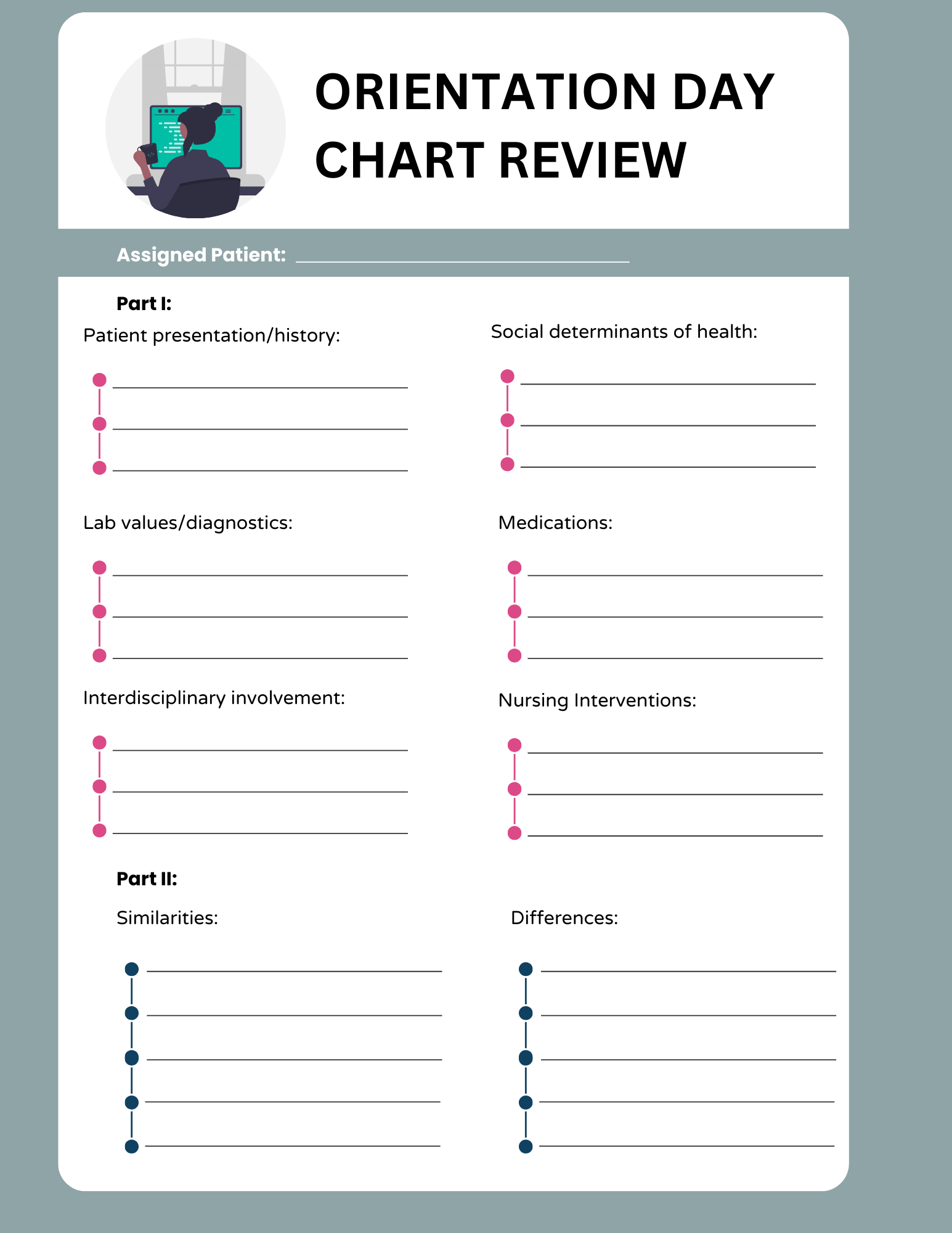
- Then, pair up the students assigned the same type of patient. Ask them to find five similarities and five differences between their patients. These findings could be:
Patient presentation
Patient history
Social determinants of health
Lab values or diagnostics
Medications
Nursing interventions
Involvement of interdisciplinary team members
4. When you come back together as a large group, have students share their diagnosis and the five similarities and differences they found.
While great for orientation day, you can also use this as a clinical activity during low census or as a make-up clinical assignment.
Worksheet Template - Option #1
I’ve created a worksheet for the advanced student version of this activity.
Students first gather information from the EMR, then compare and contrast their findings.
💡 Idea #2 - Orientation Day Observation
This activity gives students practice on the first step in clinical judgment: noticing.
- Assign students one patient on the unit. Give them absolutely no information on the patient besides their name and birthdate.
- Instruct the students to enter the patient's room, introduce themselves, verify the patient's identity, and gather a set of vitals.
📌 Note: Choose appropriate patients for this activity to avoid sending students into an unsafe situation. Please tell students about any patient restrictions, such as no blood pressures on the left arm. That kind of information is essential to share!
You can do the debriefing in one of two ways:
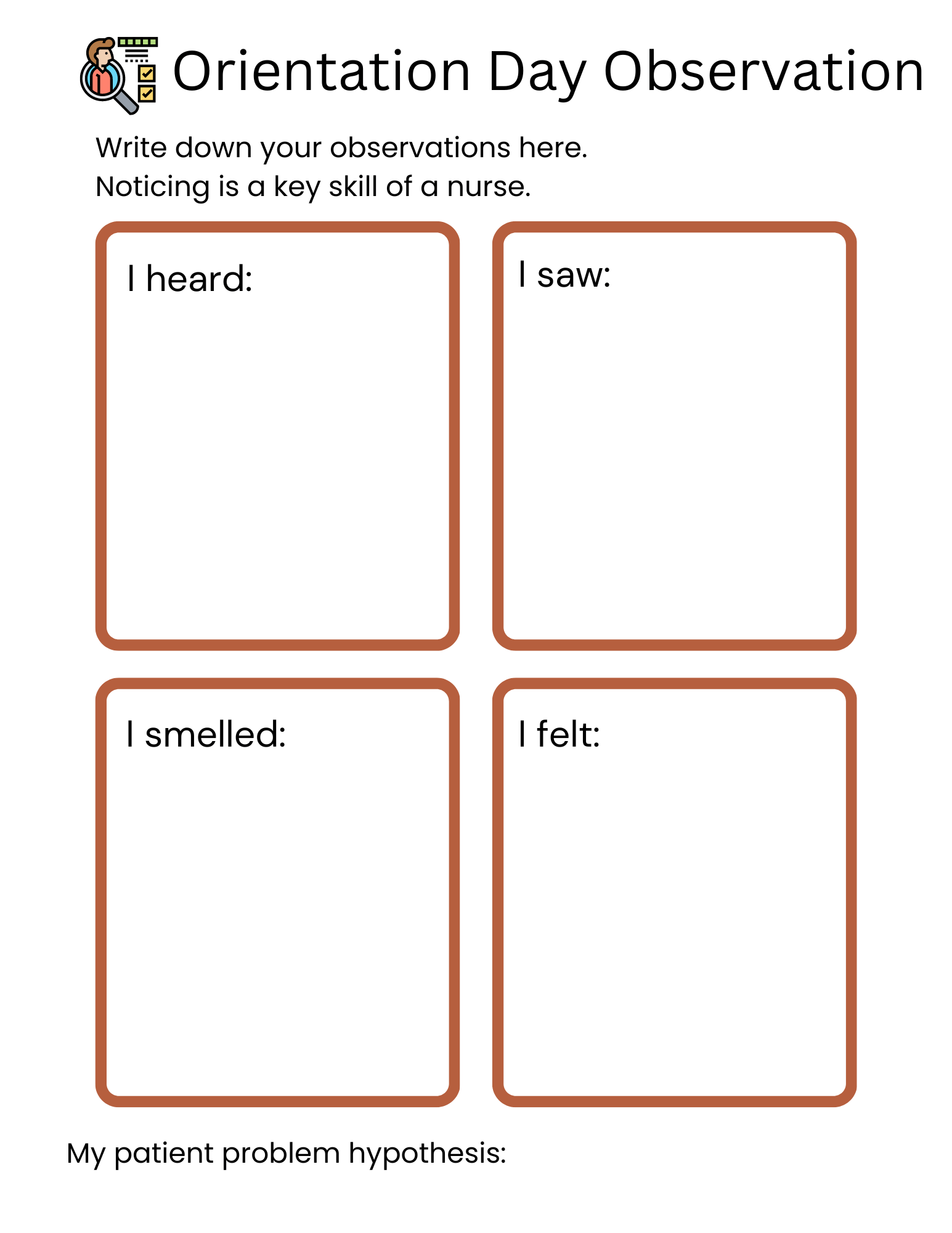
Do not tell the students the goal of this exercise. Only tell them that they are practicing gathering and documenting vital signs. When they leave the room, have them write down everything they noticed. Ask them to make their best educated guess about the patient's diagnosis or primary problem. After sharing this with you, ask them to review the patient's chart and see if they were correct.
OR
Tell the students that you want them to discover the patient's diagnosis. Knowing the goal will sharpen their observation skills and make them more aware of what to look for when they enter this activity. They will likely gather more relevant information. When they come out of the room, ask them to write down everything they noticed and see if they can determine the patient's diagnosis or primary problem. Then, they can review the EMR and see how close they were to the correct scenario.
You can decide whether students can use "interview" as one of their noticing skills. The activity will work either way, but students could ask about pain or difficulty breathing. You can limit what they ask, or let the patient explain their diagnosis.
Worksheet Template - Option #2
Students enter the room to take vital signs and practice observation and noticing skills.
Clinical orientation day can feel overwhelming, with quite a bit of expectations to cover. Adding in a short clinical thinking activity can boost the energy and allow your students to practice skills they will need on the clinical unit without the overwhelm of a patient assignment.
If you are looking for an engaging, low-stakes tool to use during orientation day on a clinical unit, you now have a plan!
🪴 Benefits of a clinical orientation day activity
By implementing either of these strategies as active learning at clinical, instructors can foster a positive, exploratory learning environment that warms up the mental muscles needed for a successful clinical rotation.
Adding a large-group debrief after either activity can build a sense of community and help learners get to know one another.
An interactive orientation day can set the tone for the entire clinical rotation and is an excellent opportunity for us as nursing educators to ease students' anxieties, introduce active learning concepts, and cultivate an environment of inquiry and kindness.
🌟 Conclusion
Orientation day is a chance to practice low-stakes clinical thinking before the reality of a full patient assignment. Chart review and observation activities let students practice noticing, prioritizing, and reasoning in a low-pressure setting, so they walk into their first real clinical day already warmed up.
Use tactics to meet students where they are. The chart review scales from a guided, single-patient walkthrough for beginners to a compare-and-contrast challenge for students ready to sharpen their clinical judgment. The observation activity builds the foundational skill of noticing before students act on what they see.
A short activity and a group debrief go a long way. Neither idea requires extra prep time or complex materials, but pairing them with a large-group discussion afterward builds community and gets students talking through their reasoning out loud.

Martha Johnson
Martha Johnson, MSN, RN is a nurse educator and the creator of BreakoutRN. She helps nursing faculty build active learning into the classroom and clinical setting, one practical idea at a time, using tools that support clinical judgment, engagement, and real-world nursing practice.
Frequently Asked Questions
How much time do these activities take on orientation day?
Both activities easily fit into an orientation schedule. The chart review can run as short as 20–30 minutes depending on group size, and the observation activity typically takes just a few minutes per student, plus time for debrief.
Do students need any prior EMR experience for the chart review?
No. The beginner version is for students brand new to the charting system. The compare/contrast version suits students who already feel comfortable navigating charts.
What if I don't have two patients with similar diagnoses for the advanced chart review?
It works best if you can find two similar diagnoses. If your unit's census doesn't cooperate on orientation day, you can save this activity for a low-census day or use it as a make-up clinical assignment.
How do I keep the observation activity safe for students and patients?
Choose patients carefully, and always share any relevant restrictions (like no blood pressure on a certain arm) before students enter the room. The goal is safe, guided noticing, not throwing students into an unfamiliar situation unprepared.
Can I use the worksheet templates with any EMR or documentation system?
Yes. Both templates are built around the thinking process, not a specific EMR layout, so they can be adapted to whatever charting system your program uses.

