

Table of contents
I want to encourage you to experiment with "stations" as a teaching tool. It is awesome to watch the engagement fill the room when groups of students move through a set of stations. Something shifts in the room, the energy picks up, it gets louder as the discussion happens, and time seems to speed up as everyone is focused on the goal.
Susan Hrach would call that embodied learning, and in her book Minding Bodies, she explains why that distinction matters so much. Learning that involves the whole person, not just the thinking brain, tends to stick. And stations, it turns out, are a remarkably natural way to create that kind of experience.
Because stations involve muscle movement, the sensations we feel, the sounds of equipment we use, and the discussions we have with others, they are an excellent tool for educators looking to add more movement to their lessons.
🗒️ Using Learning Stations
We are all familiar with stations:
designated areas within a classroom where students rotate through, and each location has a different activity and learning objective.
Setting up stations is a simple and effective way to add physical activity to any classroom session. Even a basic station setup, such as moving to a different table to work, can spark curiosity and engage the student.
🧰 Types of Learning Stations
Here are a few basic types of active learning stations:
👋🏾 Hands-on Station
This is a place to practice clinical skills, use relevant equipment, or create with art supplies.
Bring wound dressings or nasal cannulas to a station and allow students to work with the materials while creating a teaching plan for their patient.
Ask students to draw concept maps or create patient teaching materials using art supplies.
💻 Technology Station
Include any technology you have access to at a station. If it is a tablet, ask students to create a mind map using a free tool such as Canva. Work on pharmacology and medication safety using a medication dispensing system like Sim2Grow. If you can access an EMR, ask students to complete documentation on a patient in a case study. Or wheel in a low-fidelity simulator that can be used to practice basic assessment skills.

📚 Research Station
Ask students to use the tools available through your college to check medication compatibility, research a health condition, or look up evidence-based practices related to the content. They could use the library website, a drug book, or an online resource such as Nursing Central.

📝 Assessment Station
This station could include a quiz with practice NCLEX questions, a worksheet, or a skill demonstration.

🔮 Self-Reflection Station
Including a dedicated space for reflection allows students the time and energy to review their performance and identify areas for improvement. Self-reflection is an essential skill for nurses, and we can bring it into the classroom with a few open-ended questions.
🗣️ Small Group Station
The idea of this station is to engage two groups in discussion or debate. Offer the students a prompt, such as an ethical dilemma or to find the “best” way to do a nursing skill. Then, give them a little time to prepare their response. The key is to choose something with a grey area, where there is no right/wrong answer but an opportunity for open dialogue.
🏃🏼♀️➡️ Getting started with active learning stations
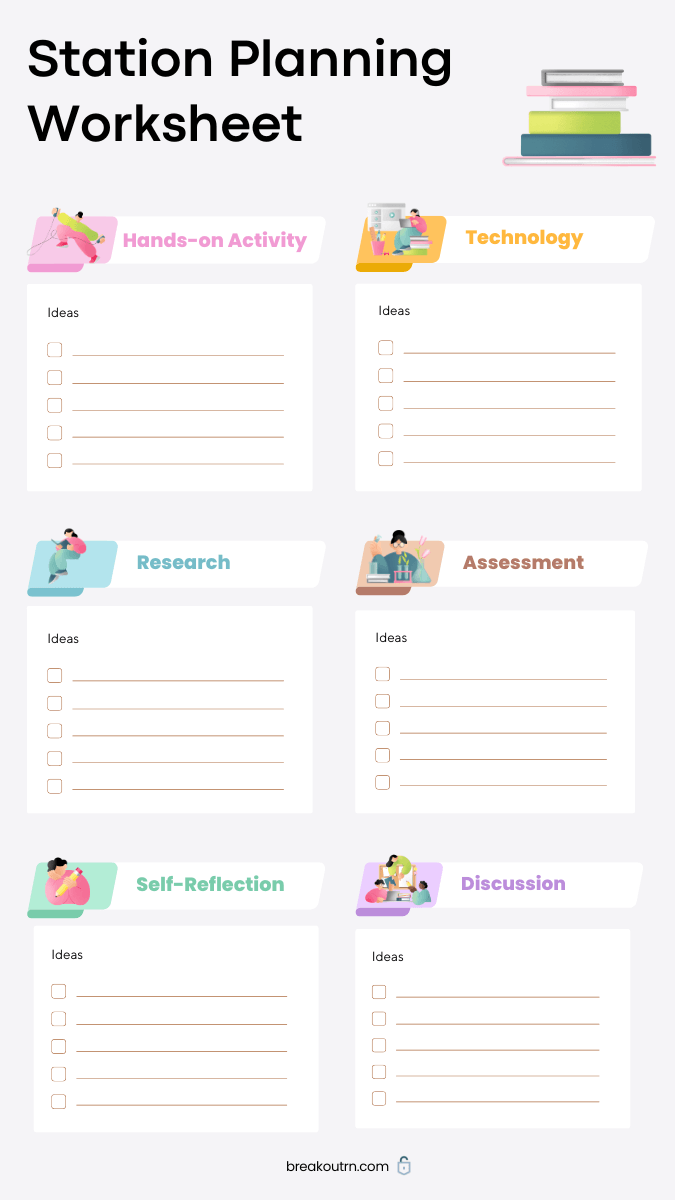
Get started planning your classroom with active learning stations with a free station planning worksheet.
📝 Additional Guidelines for Active Learning Stations in Nursing Education
Here are a few other tips for using active learning stations in your classroom or clinical:
⚖️ Balance independent and instructor-led activities
You can’t be in five places at once, so identify the activities that require your presence and include activities that students can do independently. Self-directed learning is a skill that students may need to practice, including staying on task and completing their objectives. This independence also helps them take ownership of their learning and transfers the responsibility from the instructor to the student.
🦜 Over-communicate
Give clear instructions and expectations around independent stations. Explain how it connects to nursing practice.
📌 Schedule a debrief or cool-down activity
If students have been working independently throughout the class period, use the last 10-15 minutes of class to bring the students together and debrief on what was learned. The debriefing can be a student-led activity, asking them to share one crucial concept they took away from each station. It can be the reflective station, where students identify what went well and what did not. Or it can be an opportunity to check their work as you go through the correct responses.
🖼️ Provide a framework
Giving students a guide or a worksheet to fill out as they work through the stations helps keep them on track. It can be as simple as four quadrants (if you have four stations) or as complex as a fill-in-the-blank setup. You can ask students to submit the completed sheet at the end, or they can keep it for their notes.
🩺 Align the stations with clinical practice
Consider the skills an entry-level nurse would need to work with a patient with CHF, and build your stations around these concepts.
🤸🏾Use the in-between
The time between stations is a chance to add a bit of fun and light-hearted energy to the session. Lead them through a few neck stretches or play upbeat music. Use a timer with a unique sound to signal the time to rotate stations.
💡Adding Stations to Your Teaching Toolbox
Using stations, nursing instructors can create an embodied learning experience for students. Stations give nursing students a chance to learn the way Hrach describes: with their whole selves, not just their notes.
When they move through a well-designed set of stations, they're building memory, connecting theory to practice, and sharpening their clinical judgment in ways that a lecture simply can't replicate. If you're looking for one active learning strategy to add to your teaching toolbox, this one is worth trying.
Consider adding this active learning tool to your teaching toolbox! I hope you will check out Part II of this series - Advanced Stations in Nursing Education.
Conclusion
Stations are one of the most versatile active learning tools a nurse educator can use. By rotating students through designated areas with different activities and objectives, instructors can add movement, discussion, and hands-on practice to any classroom session.
Embodied learning is exactly what stations are designed to create. When students engage their whole selves through muscle movement, equipment, and peer discussion, learning tends to stick in ways that passive instruction can't replicate.
Getting started doesn't have to be complicated. With a few simple guidelines, balancing independent and instructor-led activities, over-communicating expectations, and scheduling a debrief, you can build a station experience that deepens clinical judgment and connects theory to practice.

Martha Johnson
Martha Johnson, MSN, RN is a nurse educator and the creator of BreakoutRN. She helps nursing faculty build active learning into the classroom and clinical setting, one practical idea at a time, using tools that support clinical judgment, engagement, and real-world nursing practice.
Frequently Asked Questions
How many stations do I need to run a successful session?
There's no magic number. Even a basic setup with two or three stations can be effective. The key is that each station has a clear activity and learning objective. Start simple, and build from there as you get more comfortable with the format.
How do I manage a classroom where students are working independently at different stations?
The trick is planning ahead. Identify which activities genuinely need your presence and design the remaining stations to be self-directed.
Clear written instructions at each station go a long way, and giving students a worksheet or guide to fill out as they rotate helps keep everyone on track.
Wrapping up with a 10–15 minute group debrief also brings the room back together and reinforces what was learned.
Do stations work if I don't have a lot of equipment or technology?
Absolutely! While technology and simulation equipment can enhance a station, they aren't required.
A research station can use a drug book or a library website. A reflection station needs nothing more than a few open-ended questions on a sheet of paper. A small group discussion station just needs a good prompt. Stations are flexible enough to work within whatever resources you have available.
What other active learning tools are available from BreakoutRN?
BreakoutRN offers a growing library of active learning resources, including unfolding case study card decks, clinical decision cards, tabletop case study kits, worksheets, templates, and educator guides designed to strengthen clinical judgment without overwhelming faculty.
Additional Active Learning Ideas & Inspiration


Looking for an activity to use in a station?
Check out our clinical decision cards.
They offer clinical scenarios that students may not always be exposed to, but are beneficial to think through!
Learn how to use them HERE.