

Table of contents
Previously, I posted an article about how to use basic stations effectively as a nurse educator. To review, stations are a form of embodied learning that involves using our senses and movement to connect our brains to the learning experience.
If you are interested in learning more about this concept, I highly recommend Dr. Susan Hrach’s book Minding Bodies.
This article extends that idea to a more advanced type of station activity. In this version, the stations are sequential and must be completed in order, following a patient's care plan or a clinical judgment model of your choice.
⚡A special thank you to my friend Laura Stephenson. This article is inspired by an activity she created that we used for years while teaching together. I hope we can work together again soon. …
🤸♂️ What is a Moving Case Study?
A moving case study is a set of sequential stations designed to guide students through a case study.
It is easiest to build this activity from an existing case study. You can create a new one or use one you already have that needs a little pizzazz added.
Overall Plan
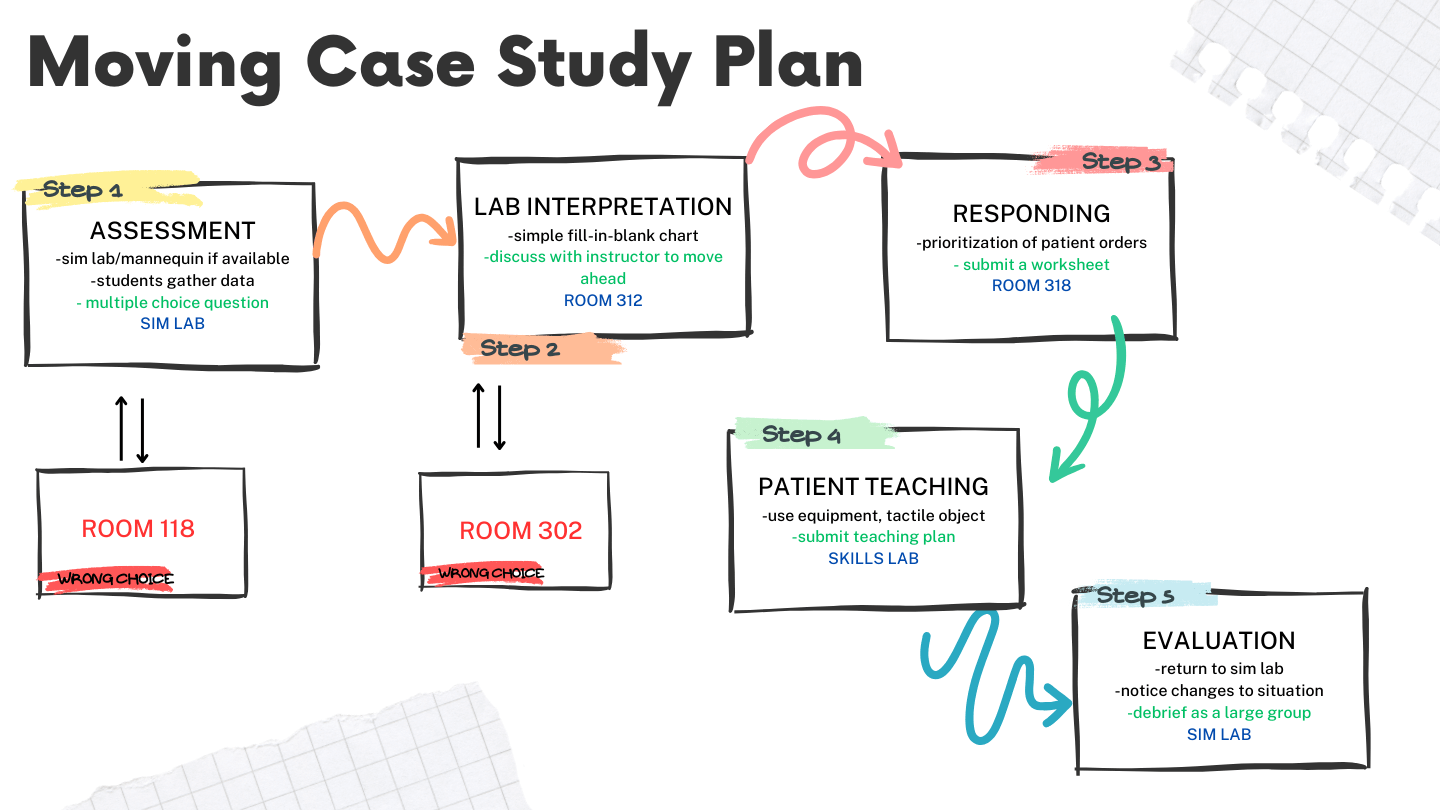
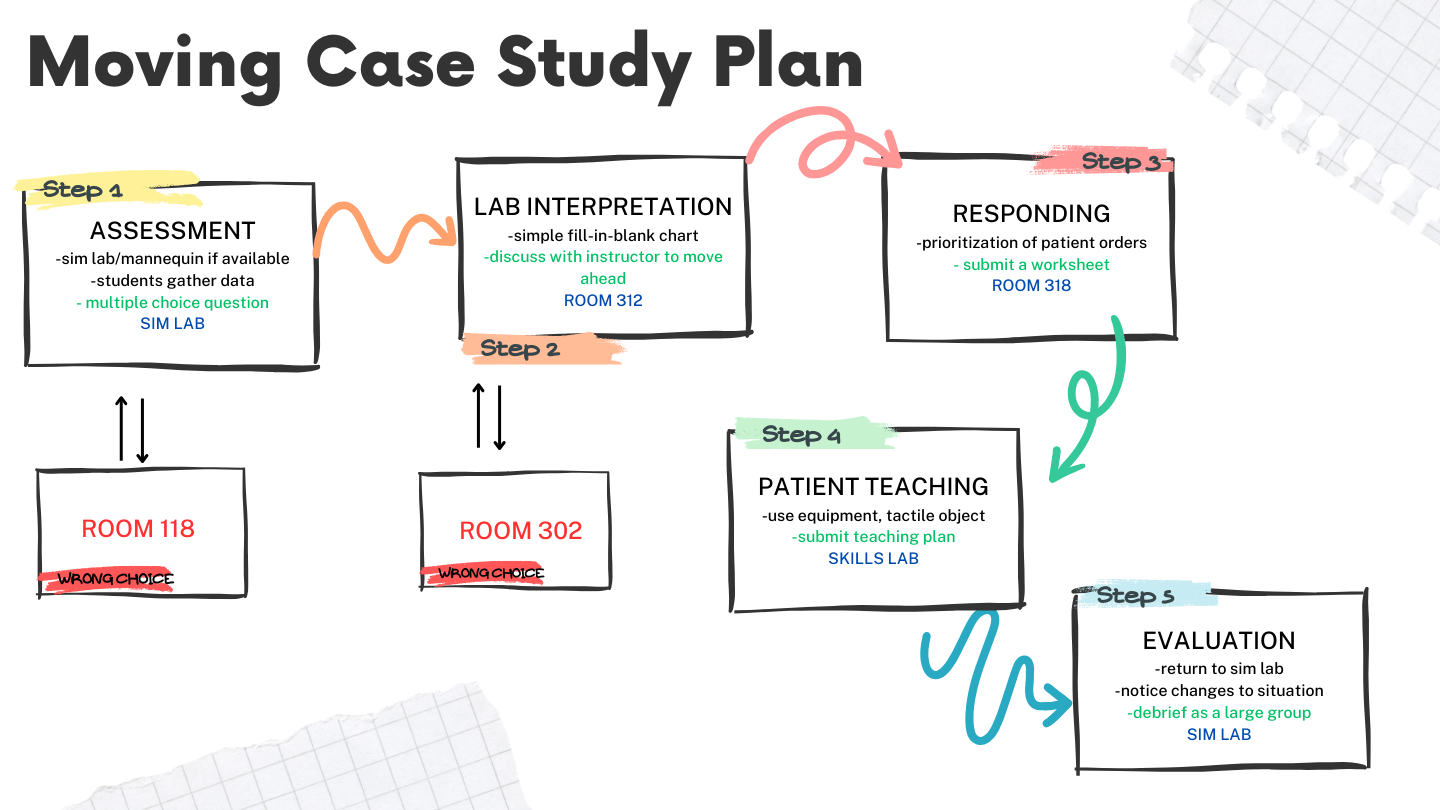
This image maps out each station in the case study so you can see how they fit together before we dive in.
This format uses an unfolding scenario, meaning students gather information as they move through each station rather than receiving the full patient picture up front. It's a small but important design choice because it mirrors how information actually arrives in clinical practice.
💡 General Overview of this Nurse Educator Teaching Strategy
The flow of this case study mirrors the nursing process.
✅ Start by asking students to gather initial assessment data or vital signs. This does not need to be elaborate; it can even be done with a low-fidelity mannequin if you can bring that to the classroom.
🚩 Then, create the problem by offering additional assessment findings that students need to notice. Ideas include:
- An IV running at an incorrect rate
A volume of urine collected in a foley bag
Excessive bleeding or drainage that is under the bed sheets
Incorrect oxygen equipment or O2 titrated incorrectly
Whatever makes sense for your case study content
🏁 Next, build an exit question to move to the next station. An exit question can be a practice question, nursing intervention, or clinical decision. Once students have gathered the data, they must complete this exit question/activity to move to the next station. Here are a few examples of an exit activity:
If O2 saturation is low, place the patient on a nasal cannula
If the patient complains of pain, have them look at a MAR or give a medication
If they discover an incorrect IV rate, they should re-program the pump
If there is an abnormal assessment finding, such as edema or crackles in the lungs, they should document it in the EMR.
🗺️ Continue this pattern (provide data, give students a task to complete, and include a station exit question) through as many stations as you would like.
📝 Sample Moving Case Study
Let’s see this as a complete example:
Station #1 - Sim Lab - Patient Assessment - Noticing
The patient sustained a hip fracture after a fall and returned from the OR yesterday evening. The mannequin is set to be hypotensive and tachycardia, with all other vital signs normal. The patient has a foley with minimal urine output.
Students could learn through the EMR that the patient had an elevated estimated blood loss in surgery. You can complicate things further by not having the ordered fluids attached to the patient or running at a TKO rate instead of 100ml/hour.
Now that the students have noticed this data, prepare the exit question. These can be done as a short, alternative-format quiz online (accessible via a QR code). Or it can be a printed paper quiz that they take to each station. If you really want to increase the movement, try this:
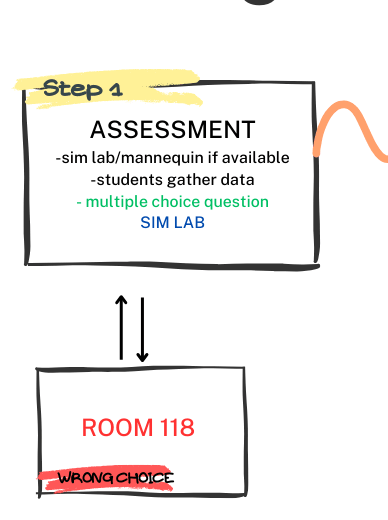
🌟 Have a multiple-choice question posted. In this case, it could be “Which lab value is most concerning to the nurse in this scenario?” Then, prepare four laminated cards, each containing a potential answer.
- The correct response directs students to the next station (Go to Health Science Room 312), where they find station #2.
- The incorrect choice directs them to an incorrect location (Go to Health Science Room 118 - a different room down the hall). Here, post a sign that indicates they chose incorrectly, and direct them back to station #1 to try again.
Even if students choose incorrectly and take the time to walk to a different room, the movement will bring life to your classroom. They will debrief their choice on the way back and discuss within their group what they will do or how they will make a different choice. You will sense the palpable energy and feel the difference in how students engage with the materials.
Station #2 - Classroom - Lab values - Interpreting
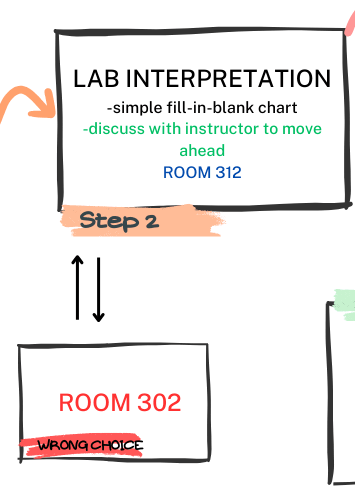
The next learning objective is about interpreting lab values.
Here, ask students to complete a simple worksheet of the patient’s CBC, BMP, and coagulation values. In this scenario, the students will determine whether each value is high or low, then write a few sentences explaining why their hemoglobin is low or their creatinine is elevated.
Design the exit question around the elevated creatinine to guide students' thinking toward acute renal injury. A few ideas:
- Something similar to the strategy above that uses a multiple-choice question about potential complications.
- A short interview with you, where each group must present in three sentences what they think the priority problem is, and give a supporting rationale. This interview exit question allows students to verbalize their thinking and allows you, as the instructor, to guide them if they are going off course.
If they are correct, direct them to station #3.
Station #3 - Classroom - Provider Orders/Medications/Patient Teaching - Responding
The next station could include a variety of tasks depending on your learning objectives for this case study.
You can include nursing skills such as
- emptying a foley
- calculating a complete I&O
- or inserting a second IV.
You can ask students to describe or draw the pathology of prerenal causes of acute kidney injury.
Students could write an incident report for the IV that was running incorrectly.
You could ask them to complete a patient teaching worksheet or a medication reconciliation.
Depending on your case study, you could include more than one nursing intervention or responding scenario. This section does not need to be only one station; it could be an infinite number of stations, depending on your learning objectives.
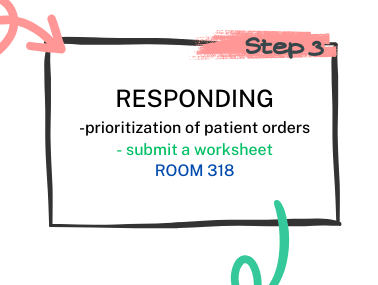
This would be an example of a second station that you could add to your moving case study plan. It would be classified as "responding" in the CJM but covers a different learning objective than step #3, and therefore should be a seperate station.
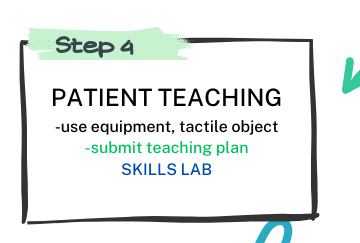
Patient teaching activities make a great station because they are highly independent and require minimal instructor supervision.
For this station, the instructor would set out equipment that the patient may use upon discharge, such as crutches or a nebulizer. Using a framework or worksheet, students would work through patient teaching points for using that piece of equipment.
Final Station - Sim Lab - Evaluation
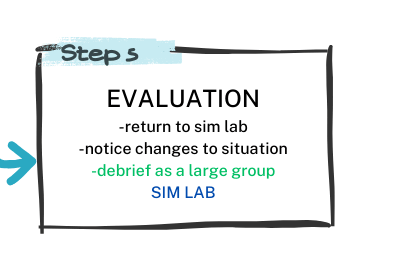
Once students have completed all of the “responding” stations, they can return to the patient and re-assess. This is the 'evaluation' phase in the CJM.
Again, this will depend on the case study, but the patient can improve or decline. Students could begin preparing the patient for discharge or find the patient unresponsive. Either choice is great as long as it connects to your learning objectives.
⚡️ Create your own Moving Case Study
Here is a visual example of a completed plan for a moving case study. You can download this document as a template for your own project development.
Stations are a great way to incorporate movement and add energy to your classroom. Building a sequential set of stations that guide students through a case study and the nursing process is a more advanced nurse educator teaching strategy. However, with a solid plan, it is an excellent way to build clinical judgment and incorporate active learning.
Conclusion
Start with a case study you already have. You don't need to build from scratch. This activity can quickly apply to a case study that's working. By adding the sequential structure, exit questions, and movement between rooms, you will bring it to life.
Adding physical movement between stations, even if it is directing students to the wrong room, creates energy, discussion, and engagement that you simply can't replicate sitting in lecture.
The clinical judgment model is already built into this activity. When students move through noticing, interpreting, responding, and evaluating, they're practicing clinical judgment without it feeling like the same old case study.

Martha Johnson
Martha Johnson, MSN, RN is a nurse educator and the creator of BreakoutRN. She helps nursing faculty build active learning into the classroom and clinical setting, one practical idea at a time, using tools that support clinical judgment, engagement, and real-world nursing practice.
Frequently Asked Questions
Do I need a simulation lab to run a moving case study?
Not at all. While a sim lab adds a great layer of realism for the assessment station, it isn't required. A low-fidelity mannequin in a corner of the classroom works well, and some stations can rely entirely on paper-based scenarios, worksheets, or QR codes. Use whatever resources you have access to and build from there.
How do I manage students who finish stations at different speeds?
Building a buffer into your station design helps. Include an extension task or a reflection prompt at each station that early finishers can work on while waiting.
Clear written instructions at every station also reduce the number of times students need to find you for guidance, which keeps the flow moving more naturally.
How long does it take to run a moving case study?
That depends on how many stations you include and how complex each one is.
A three- to four-station moving case study can fit comfortably into a 75–90-minute class period.
If you have more learning objectives to cover, consider spreading it across two sessions or building in stations that students can complete more quickly to keep the momentum going.
What other active learning tools are available from BreakoutRN?
BreakoutRN offers a growing library of active learning resources, including unfolding case study card decks, clinical decision cards, tabletop case study kits, worksheets, templates, and educator guides designed to strengthen clinical judgment without overwhelming faculty.

