Teaching Students to Think Backward with Fishbone Analysis for Active Learning in Nursing Education
Time to read 7 min

Time to read 7 min
Table of contents
Beginning with the end in mind can be an effective teaching strategy. The concept of working backward is a popular and well-worn idea. For example, in Stephen Covey’s 7 Habits of Highly Effective People, one of the habits is “Begin with the End in Mind.”
At its core, working backward is about clarity. Instead of starting with the task in front of you, like today’s lecture, this week’s slides, the next exam question, you zoom out and ask: What do I actually want students to be able to do?
We can start to design our lessons backward from the nurse we hope they become. Here is how this may look:
Working backward also reduces overwhelm for you as the educator.
Instead of feeling pressure to “cover everything,” you filter content through a simple question: Does this help them reach the outcome? If it doesn’t, it may be interesting, but it might not be essential. That clarity makes lesson planning more focused and removed infobesity.
Backward course design emphasizes beginning with what the educators want students to know by the end of the lesson or semester and planning activities and assessments around this goal.
While working backward typically applies to the behind-the-scenes work of the educator, we can also use this concept as a clinical judgment activity. Simply giving students a framework (and a template provided below) is a great way to approach clinical problems from this backward thinking approach.
The nursing process is cyclical, and practicing nurses constantly move between assessment, analysis, intervention, and evaluation sometimes within seconds. In this fishbone activity, we intentionally place students at the “responding” phase first. Using Tanner’s Clinical Judgment Model, instead of beginning with assessment data and asking, “What’s happening?”, we start closer to the intervention and ask, “Why did this happen?” or “What led to this decision?”
By structuring the activity this way, students begin to recognize patterns. They start to see how small data points accumulate into larger clinical changes. The visual design of the fishbone allows them to categorize contributing causes (assessment findings, pathophysiology, environment, team communication, etc.) while collaboratively unpacking the reasoning behind the response.
Think of how you usually teach ABG interpretation.
First, you teach students how to interpret the pH, CO2, and bicarb.
Then, you give them the lab values, and they interpret.
This technique is terrific practice at the understanding level.
But we can level this up. Doing the work backwards adds a challenge! Here, the same concept is used, but the students are given a backward thinking exercise.
Present students with the final scenario intervention, i.e., prepare the patient for intubation.
Now, ask students to work backward. Describe the patient's appearance before the ABG. Have them give values for pH, CO2, and bicarb. What are their vital signs? What was the contextual situation that led up to this condition?
Presenting the concept this way requires a deeper understanding of acid-base balance than simply interpreting an ABG.
Using any clinical scenario, give students the framework below. It begins with an intervention and asks them to reverse engineer how they reached that conclusion. It takes a different set of problem-solving skills, helps students to see their decisions from a different angle, and requires students to understand the concepts better than simple rote memorization.
To get started, simply choose the nursing intervention that the students will work backward from.
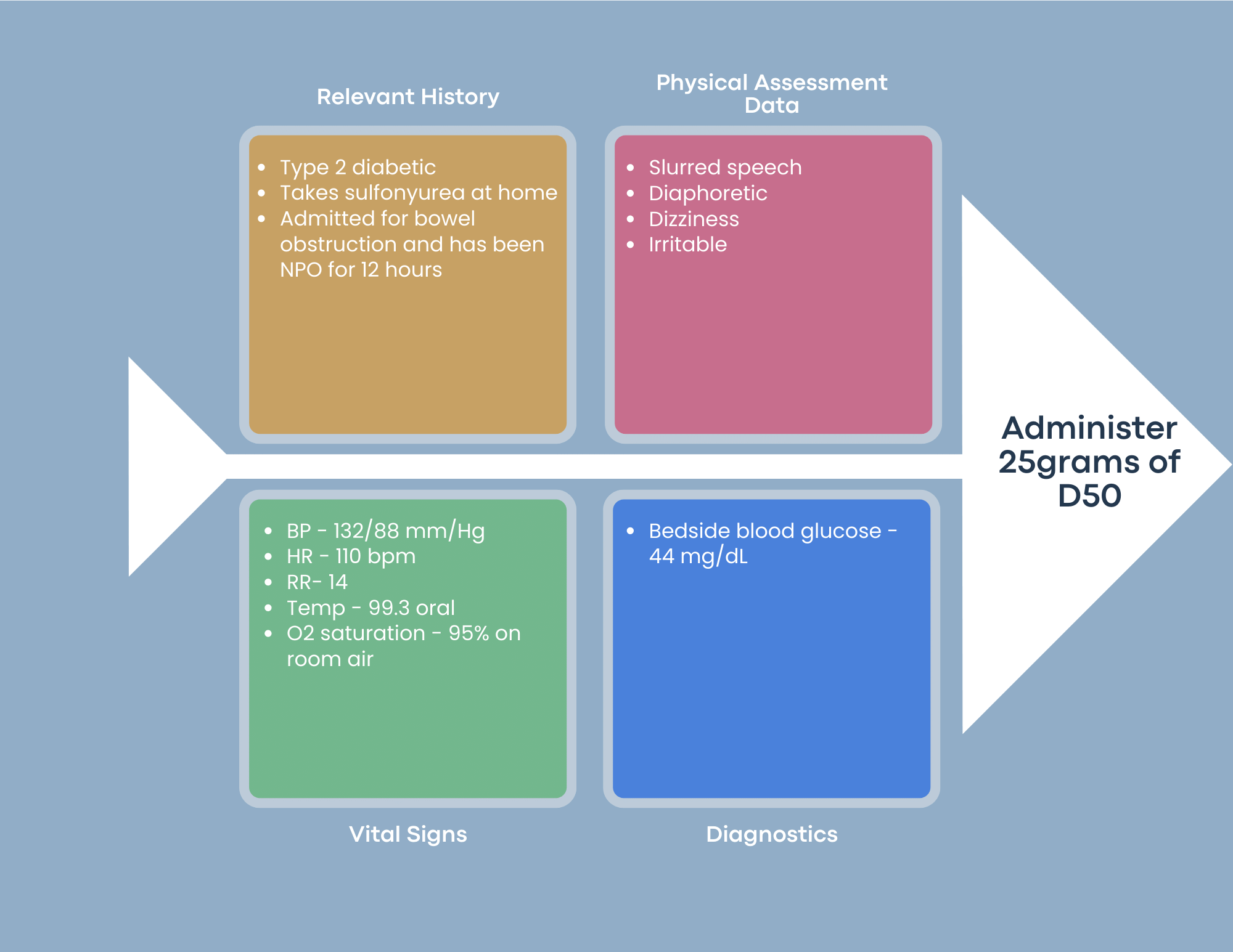
Then, have students work backward through the events leading up to the intervention, including vital signs, medical history, assessment findings, and diagnostics. Below is a completed example for the intervention “Administer 25 grams of D50".
The Fishbone Analysis gives both the educator and students the structure to work backward.
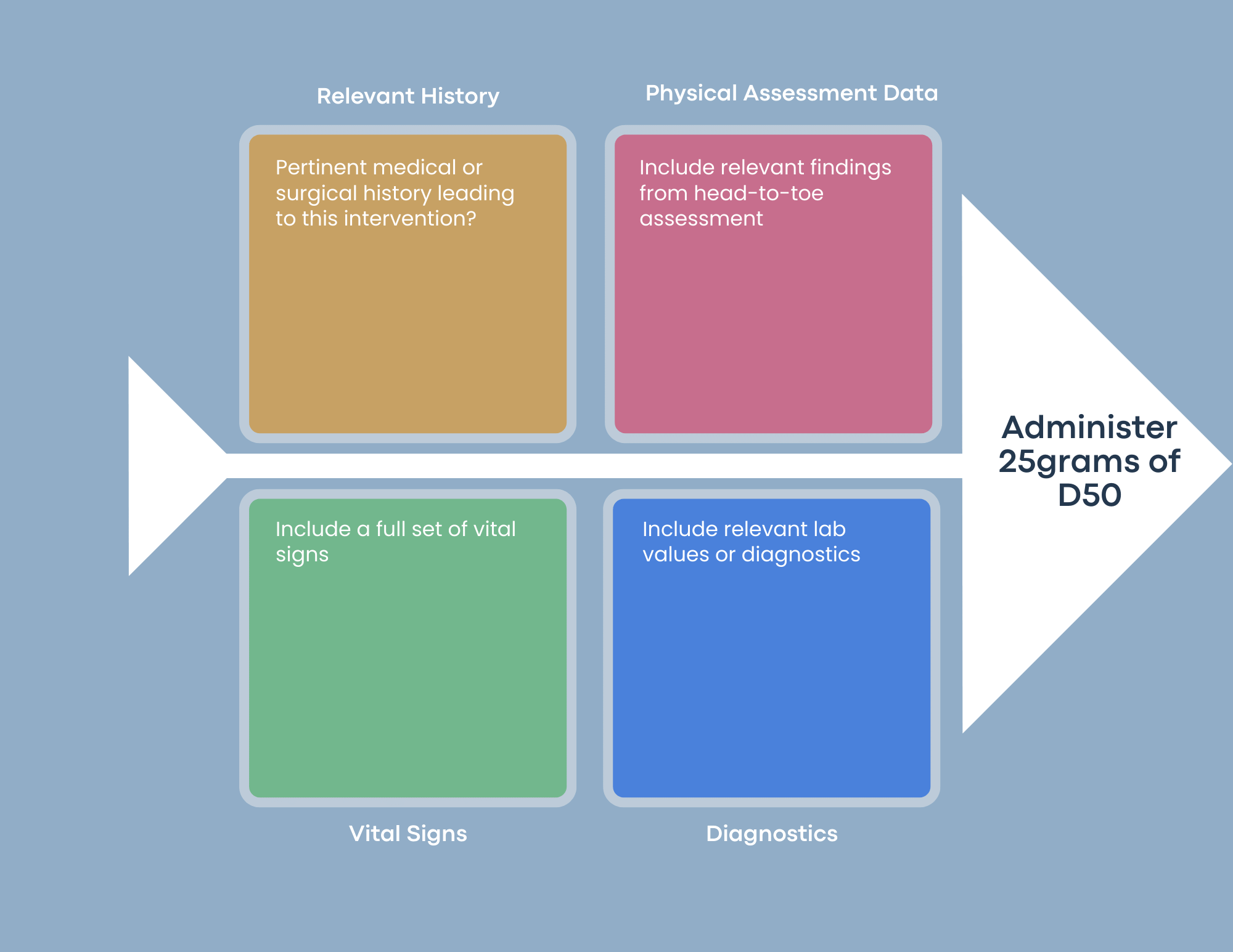
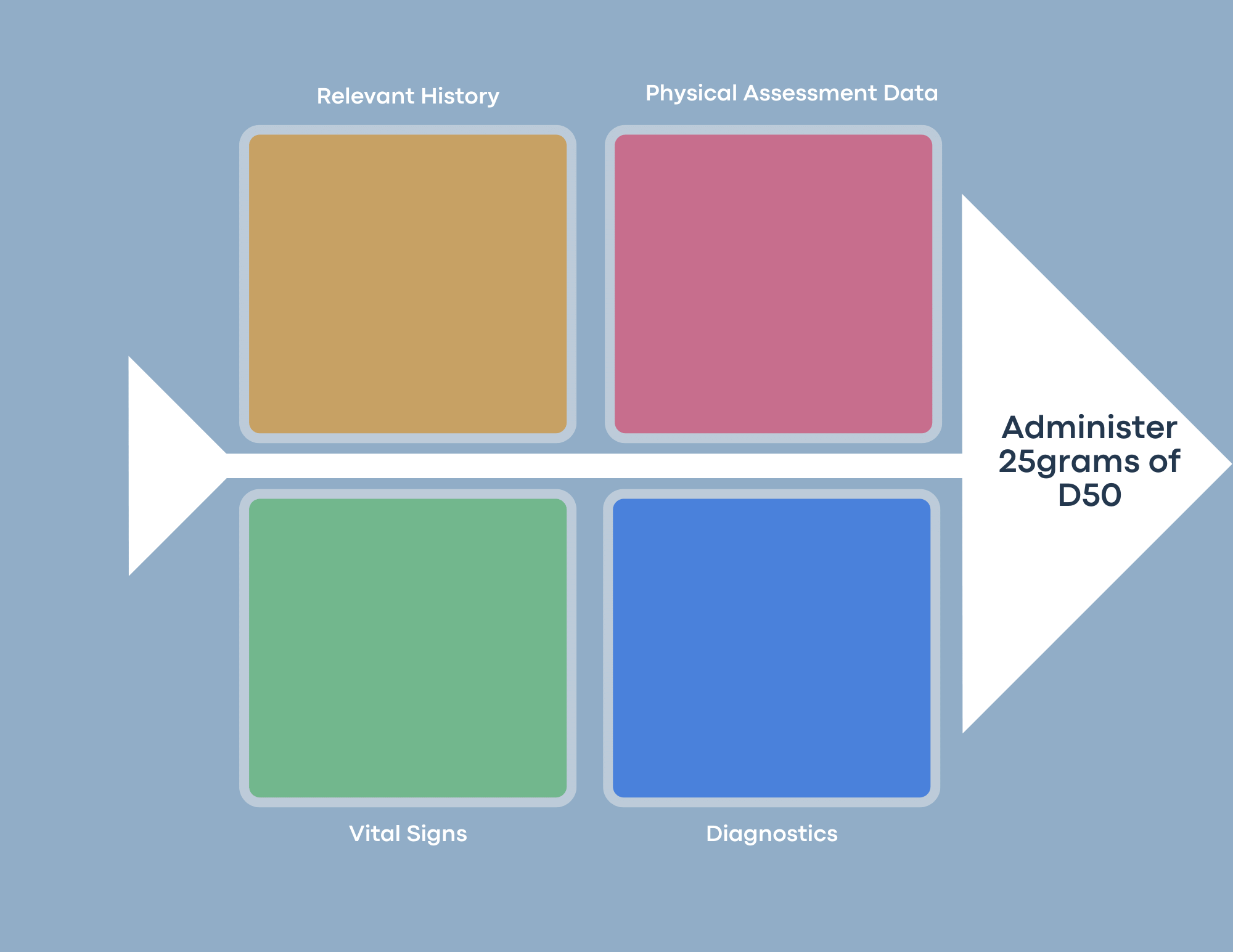
Once students have the worksheet, give them a nursing intervention to put at the fish head. In this example, the intervention is administering 25 grams of D50, shown in the diagram below.
Here are a few examples:
In this image, the fishbone gives students with more guidance and provides the question they can ask themselves to arrive at a response.
Here, students have a simple phrase at the top of the response boxes to guide their thinking.
This is how the completed worksheet will look ➡️
The beauty of this activity is that while there are right and wrong responses (the patient has to be/or at risk for being hypoglycemic), there is also a grey area regarding the patient's history, current vital signs, and assessment findings.
Depending on your chosen intervention, you could have ten completely different fishbones, which can lead to a great discussion. Imagine the possible scenarios related to a final intervention of "turn every 2 hours" or "administer packed red blood cells."
You can access the template below and start creating your own activity right away!
The fishbone analysis is an excellent option for a nursing clinical judgment activity for small groups. This activity requires higher-level thinking skills, so ensure your students have the foundational knowledge first. I like this as a small group activity, but you could also use it as an individual assignment.
For example, suppose you are teaching diabetic content. In that case, you could have a variety of interventions related to blood glucose irregularities, having different groups working on different fishbones with various nursing interventions. Also, you could ask groups to build on each other's fishbones by having students complete one section, such as vital signs, before exchanging their worksheet with another group. Then, the new group completes a different section, such as diagnostics.
This worksheet translates nicely to the online learning environment. It could be completed as an assignment or as part of a discussion board.
Rather than having students respond to two peers' posts, they work in groups, each completing an individual section of the fishbone analysis and reviewing together or commenting on another student's analysis worksheet.
As a former ER nurse, I always imagine and plan for the worst possible scenario. The fishbone analysis can help students think through emergent situations as well. In the fish head, write an emergent situation, such as a patient fall. Have them work backward to develop the clinical data before the patient falls. Maybe they had a heart arrhythmia or low blood pressure, let the students be creative.
To further work through the story development, add another fish body to the other side and have students build interventions and evaluation steps the nurse should complete after a patient falls.
Working backward is an effective teaching strategy to bring active learning to nursing education, and the fishbone analysis gives educators and students a framework to develop critical thinking.
Creating opportunities for students to practice clinical judgment is about creating the connection between knowledge and application. I hope this worksheet will make it easy for you to implement this in your classroom.
Remember, you don't have to completely overhaul all your content. Just slowly adding a few activities every semester can make a difference!
Working backward strengthens deeper clinical reasoning. By starting with the intervention and asking students to reverse engineer the scenario, you move them beyond recall and into analysis, synthesis, and decision-making.
Fishbone analysis provides structure without limiting creativity. The framework offers guardrails for thinking while still allowing multiple plausible patient stories, encouraging discussion and flexible reasoning.
Small shifts in your teaching tools create meaningful impact. You don’t need to redesign your entire course. Adding one backward-thinking activity can significantly improve how students connect theory to practice.
Martha Johnson
Martha Johnson, MSN, RN is a nurse educator and the creator of BreakoutRN. She helps nursing faculty build active learning into the classroom and clinical setting, one practical idea at a time, using tools that support clinical judgment, engagement, and real-world nursing practice.
Fishbone analysis works best after students have foundational knowledge of the topic. It’s ideal for review days, case study application, clinical post-conference, or anytime you want to move students from memorization to higher level thinking skills, like interpreting data or reasoning through patient care decisions.
Select an intervention that requires clinical judgment, not simple recall. Strong options include medication administration (give or hold a medication), escalation of care (calling a rapid response, prepare for intubation), or safety interventions (fall precautions, turning schedule). The key is choosing an action that forces students to justify why it’s necessary.
Very little once you have the template. You choose the intervention, give students the framework, and facilitate the discussion. It can be as simple as printing the worksheet and assigning one scenario, or you can build multiple variations over time and reuse them semester after semester.
BreakoutRN offers a growing library of active learning resources, including unfolding case study card decks, clinical decision cards, tabletop case study kits, worksheets, templates, and educator guides designed to strengthen clinical judgment without overwhelming faculty.
The COPD Clinic is just one example! Be sure to check out the full library.
Related product
🫁 Chronic Obstructive Pulmonary Disease (COPD)
$39.00