

Table of contents
Looking for opportunities to practice “failure” with your students? Keep reading to access the Nursing Incident Report Template!
🏔️ The Impossible Project
Have you heard of the concept of the "impossible project?"
It is a concept proposed by Paul Feigenbaum where students start a project that they cannot possibly complete in the given time frame. The project leads to "communal failure," where everyone fails a task together. The idea is that it exposes students to failure and opens up discussion about how to learn from unsuccessful attempts, including how it is okay to fail.

⛏️ Failure as a Learning Tool
There is a cultural narrative around failure. In nursing school, failure is often treated as something to be avoided at all costs. A failed quiz can feel like a verdict on someone’s future, rather than what it truly is: feedback in progress. Our systems often link grades to identity, leaving students questioning their worth or potential when they stumble.
Giving students tools to navigate failure
This is where we come in as nurse educators. While it is impossible to rewrite the cultural script around failure, we can give students meaningful practice in how to respond when things don’t go as planned.
The incident report activity you’ll find in this post is designed to do just that. It offers a structured, low-stakes way for students to reflect on mistakes, explore clinical complexity, and gain confidence navigating the uncomfortable moments in nursing practice. When used intentionally, it can become a safe place to fail and to learn how to confidently navigate these situations.
📝 How to Implement an Incident Report Activity
I have made errors as a nurse. I remember every incident in great detail. Part of what makes it so memorable is that I had to relive the moment immediately when I wrote an incident report.
An incident report can be an excellent tool for teaching. I've created a worksheet you can download and included a few ideas for using this worksheet with students.
In this activity, students create a fictional medication error. By asking them to write an incident report, it becomes a forced mistake where they can see and imagine how a failure would look and feel. By exposing them to an error in a safe environment, we can reform it into something instructive, beneficial, and constructive.
This activity forces students to accept a failure that happened, anticipate patient needs once it happens, and reflect on the emotions that will inevitably come with a medication mistake.
Nursing incident report template
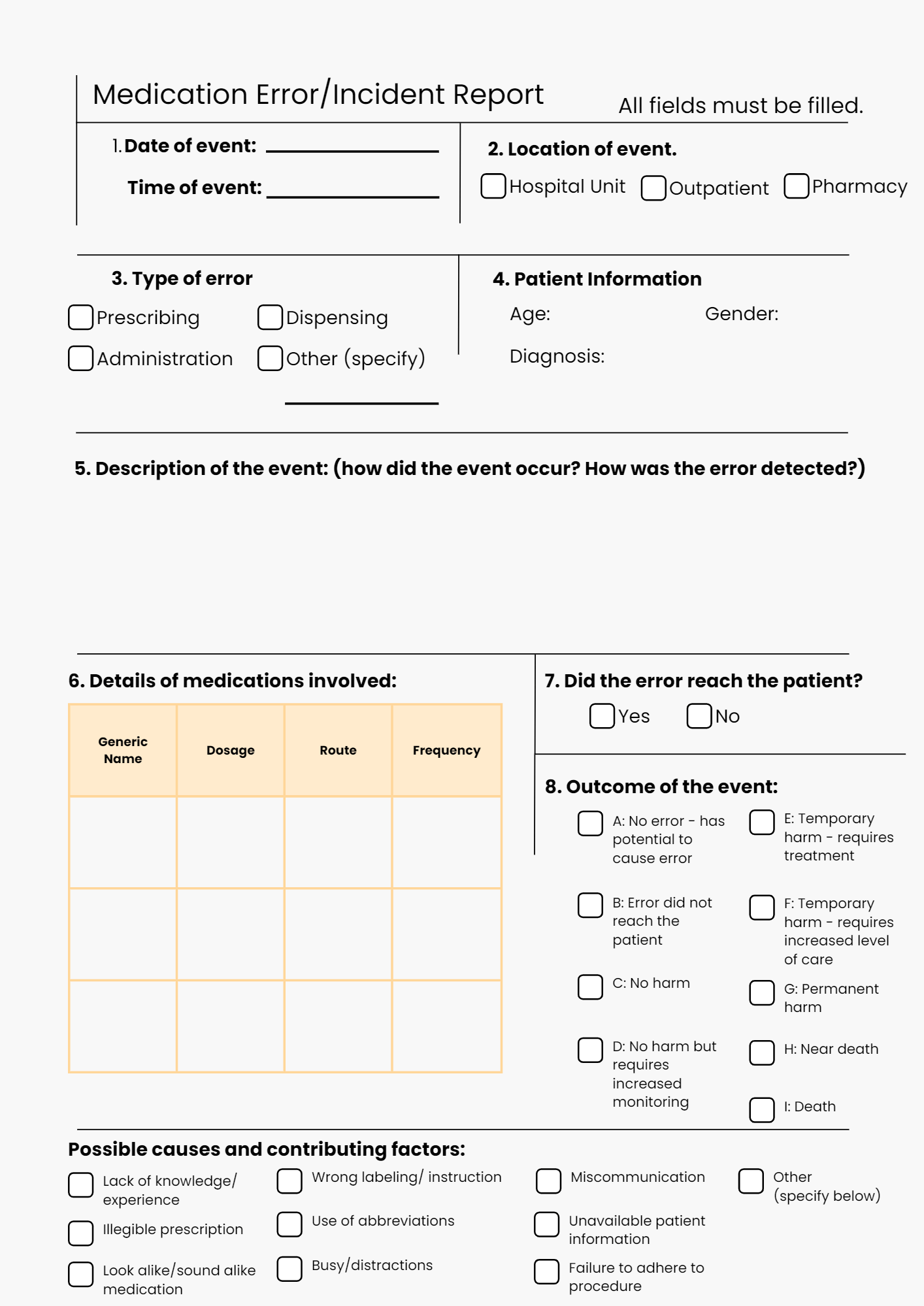
This fictional report has three parts:
- Part 1 asks students to lay out the objective details of what happened during the incident
- Part 2 begins the nursing process and asks students to imagine the care they would begin to orchestrate based on the error.
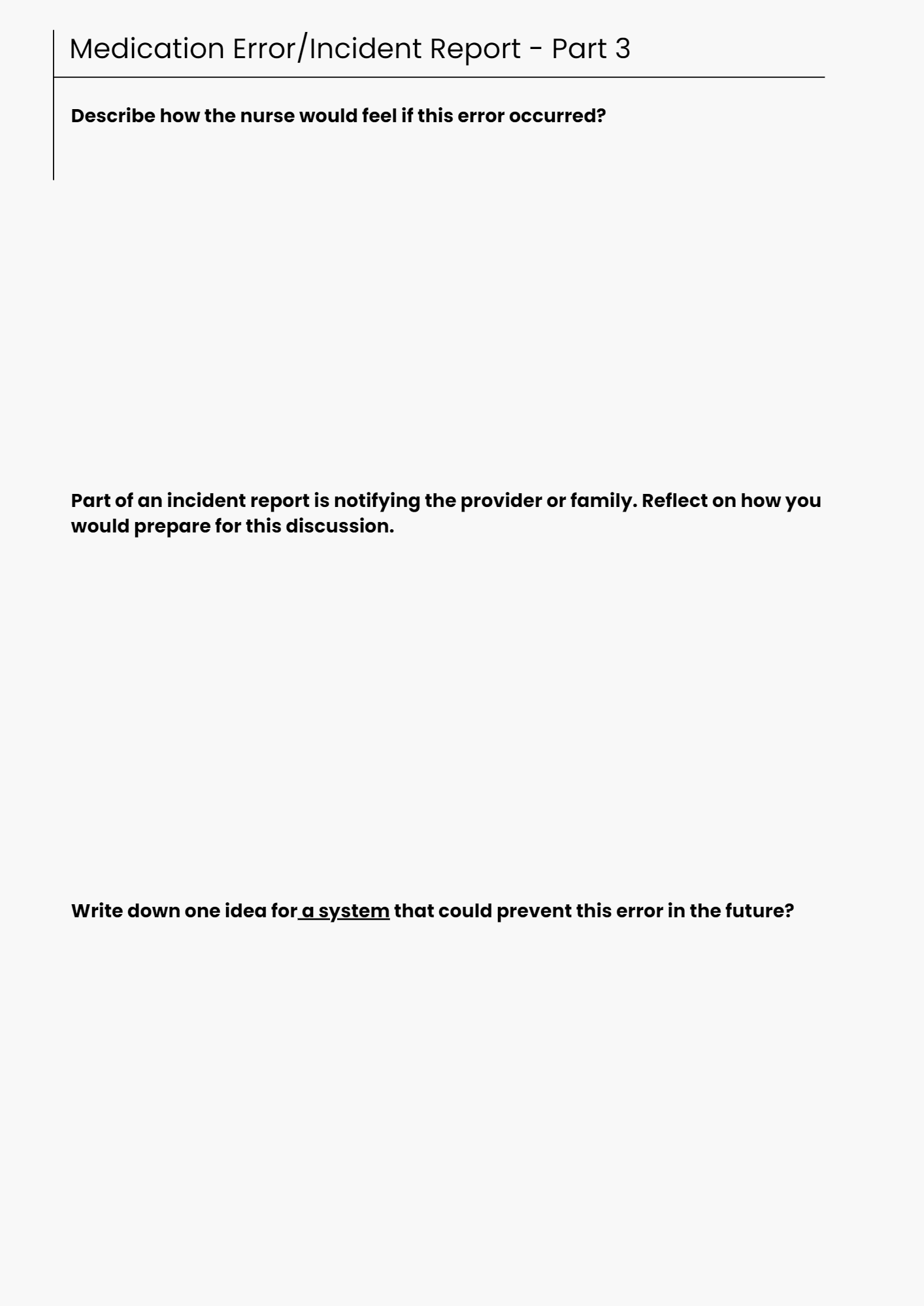
- Part 3 includes reflection questions asking students to reflect on the experience and describe a system that could prevent this error.
Part 1
Part 1 has students create a fictional error or incident.
Download the full worksheet by clicking the button below.
Part 2
Part 2 asks students to imagine the clinical scenario when the error reaches the patient.
First, what assessment data would they anticipate? For example, suppose Part 1 indicated that the patient received 10x the ordered morphine. In that case, the nurse should anticipate decreased respiratory rate, decreased level of consciousness, low oxygen saturation, etc.
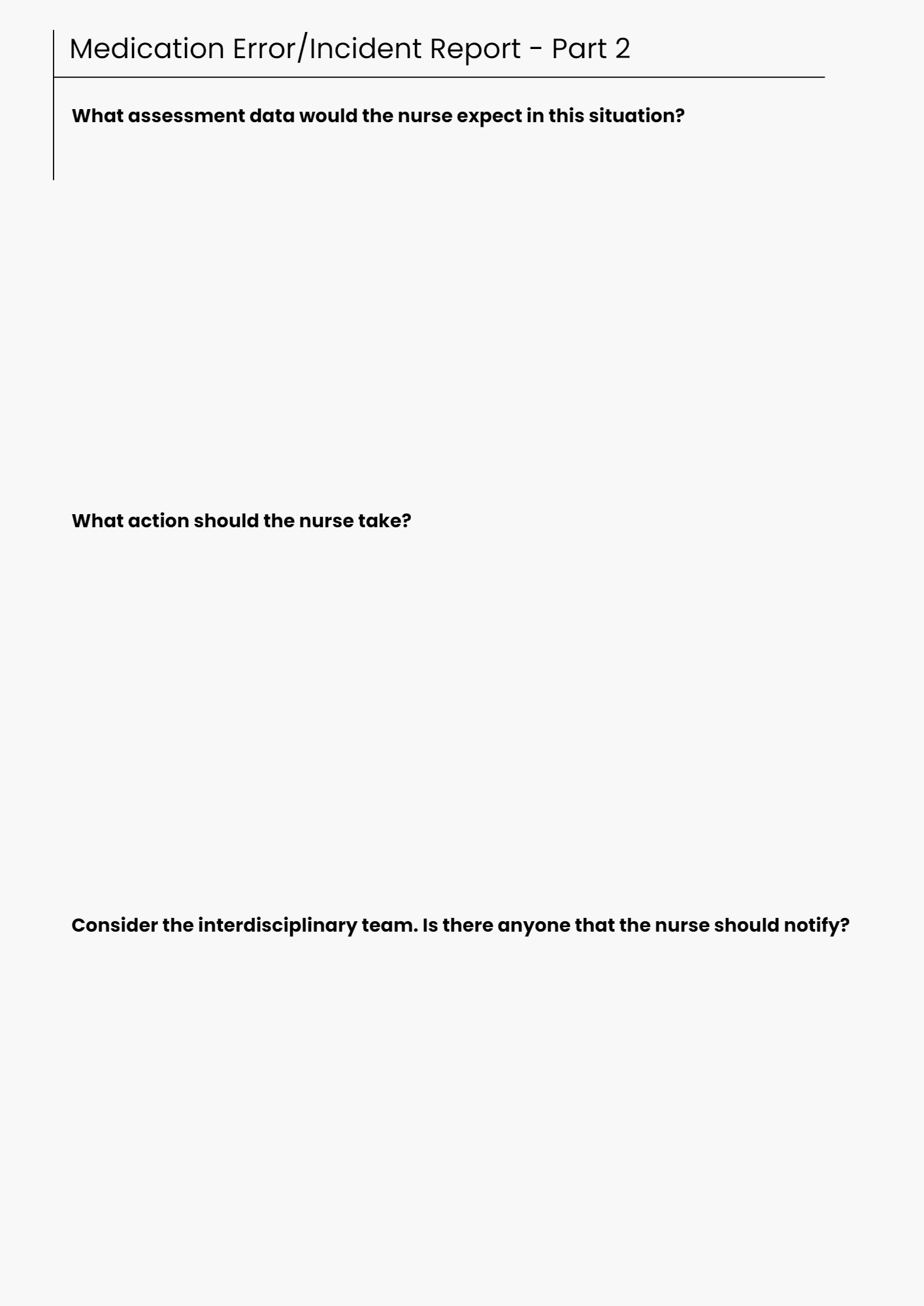
Next, students must decide what the nurse should do.
Is there an antidote available? What additional monitoring is needed? Is it lab values, diagnostics, or treatments such as dialysis?
In the final section of Part 2, students must decide who else should be involved. At the minimum, they should note that the nurse must notify the provider. But other support, such as respiratory therapy, a rapid-response nurse, or poison control, may also be options depending on the scenario.
Part 3
Part 3 asks students to reflect on the medication error. At this point, I tell students about the first time I made a medication error. I emphasize the absolute horror I felt when I found that the incident report asked for the date/time I notified the provider. I had not anticipated having to make that call, and it made the situation extremely intense for me. This section instructs students to reflect on their feelings and how they would prepare to call the provider or notify a family.
First, students are asked to reflect on how they would feel if this error occurred as well a how they would prepare to call the provider. This can bring up excellent discussion about communicating with providers in high-stress situations.
Finally, it asks for an idea for a system that could prevent the error. This question is one of my favorite parts of this activity.
Students with previous work experience in healthcare may have fantastic, innovative ideas they have seen elsewhere. Some may have worked in industries with safety standards that would translate to nursing. Others may have no ideas, so I would instruct them to head to a library resource and see what they can find on best practices related to medication safety.
📌 Looking for more pharmacology?
If you are looking for additional pharmacology-related active learning content, check out the other active learning classroom activity - Would you Give this Med? - HERE.
💡 Teaching Medication Errors in Nursing Education Using an Incident Report Template
💊 Medication errors are often the cause of incident reports in nursing. For this reason, pharmacology content lends itself well to using the nursing incident report template. But you could also use this idea for patient safety, such as falls or in a leadership course related to staffing issues or equipment failure.
In-Person Classrooms
- Start by having small groups complete Part 1 of the worksheet. Ask them to use their imaginations to create different medication error scenarios. Include medications from your current theory course or do a broad pharmacology review. Consider making errors in dosage, route, time, medication, or person; students can potentially use all or only one of the five patient rights.
- 🛑 Have the first group stop at question #7. They will need to mark "YES" here and ensure that the error reaches the patient so that the next group can complete part 2.
- Once Part 1 is complete, rotate the worksheet between groups. Instruct the new group to read the scenario. Once they understand the error, they will complete sections 8 and 9 as well as the second page of the worksheet.
- Once Part 2 is complete, you can keep the worksheet with the same group or rotate the sheets again to complete Part 3
Clinical Rotations
This worksheet can also be helpful at clinical. Here is how I use the worksheet at clinical:
Medication check-off
- I tell my clinical students if they come to me to check off their medications and have an error, it is just like having the error reach the patient.
- For example, I consider it an error if they should have pulled two tablets from the Pyxis and only have one. It is an optimal time to stress the importance of doing medication checks independently. Even though the error does not reach the patient, I have them complete this mock incident report.
- The most valuable part is when they reflect on the potential cause of the error. It is a humbling reflection when students have to write out what steps they skipped or simple safety systems they bypassed.
Storytelling
🩺There is incredible value in sharing your own experience as a nurse. Post-conference is an excellent time to share a story from your practice using this incident report form. Here is how I use the form through a story:
“As a new nurse, I bypassed the barcode scanning system and scanned my meds after administration to save time. Unfortunately, I discovered my error when I did scan the barcode. When recounting the events through an incident report, I had to include as many details as possible about the patient, the medications, the g-tube I used to administer the medications through, the steps that I skipped, and the follow-up monitoring I completed.”
Then I ask students to complete the nursing incident report template as if they were the nurse who made the error. You can use a true or fictional story, but these narratives are powerful teachers.
Virtual Option
The Incident Report template is easy to adapt to an online discussion post. As the instructor, you could complete Part 1 so that everyone has the same scenario to work from and have students submit the remaining parts as an assignment.
It would also work nicely as a discussion board assignment. For example, students could post an error they created, and responding students could answer one or two of the reflection questions.
💊 Medication Error Incident Report as an Active Learning Tool
Teaching medication errors in nursing education through completing a mock incident report is beneficial for any level of nursing student. It requires higher levels of thinking, including creating when students write out the error that occurred.
Pharmacology is often woven throughout all curriculum levels, so this activity could be used throughout a program. Even beginning students learning about safety could benefit from imagining a scenario of a patient fall or a needle stick.
Completing an incident report as a nurse is a humbling experience. It forces deep reflection on your practice, your adherence to safety protocols, and what shortcuts you have made acceptable in your work. Offering this experience to students in a safe environment can initiate this reflection before any harm reaches the patient. It is a forced failure, and these can be valuable learning experiences.
Conclusion
Reframe failure as formative. When students practice navigating mistakes in a structured, low-stakes setting, they begin to see failure as feedback instead of a verdict on their ability.
Structured reflection builds clinical judgment. Writing a mock incident report requires students to anticipate assessment findings, plan interventions, and consider system-level prevention strategies, all essential nursing skills.
Safe practice is the goal, but there may still be errors. By intentionally creating space to explore medication errors, communication breakdowns, and patient safety events, educators help students prepare emotionally and clinically for real-world complexity.

Martha Johnson
Martha Johnson, MSN, RN is a nurse educator and the creator of BreakoutRN. She helps nursing faculty build active learning into the classroom and clinical setting, one practical idea at a time, using tools that support clinical judgment, engagement, and real-world nursing practice.
Frequently Asked Questions
Is it risky to have students “practice” medication errors?
No, because the learning happens in a controlled, reflective environment. Students are not encouraged to make real mistakes. Instead, they are allowed to explore fictional or historical scenarios to build clinical reasoning, emotional resilience, and safety awareness before caring for patients independently.
Will this activity scare or discourage students?
When facilitated thoughtfully, it actually does the opposite. Students often feel relief when they realize errors can be discussed openly and constructively. The controlled environment and practice format gives them language and tools to respond professionally rather than emotionally if something goes wrong in practice.
Can this be used with beginning students?
Absolutely! The earlier you can begin demonstrating this process in a program, the better. The complexity of the scenario can be adjusted based on level. Early students might explore patient falls or basic medication safety, while advanced students can analyze high-risk pharmacology errors or leadership-related incidents. The framework grows with them.

